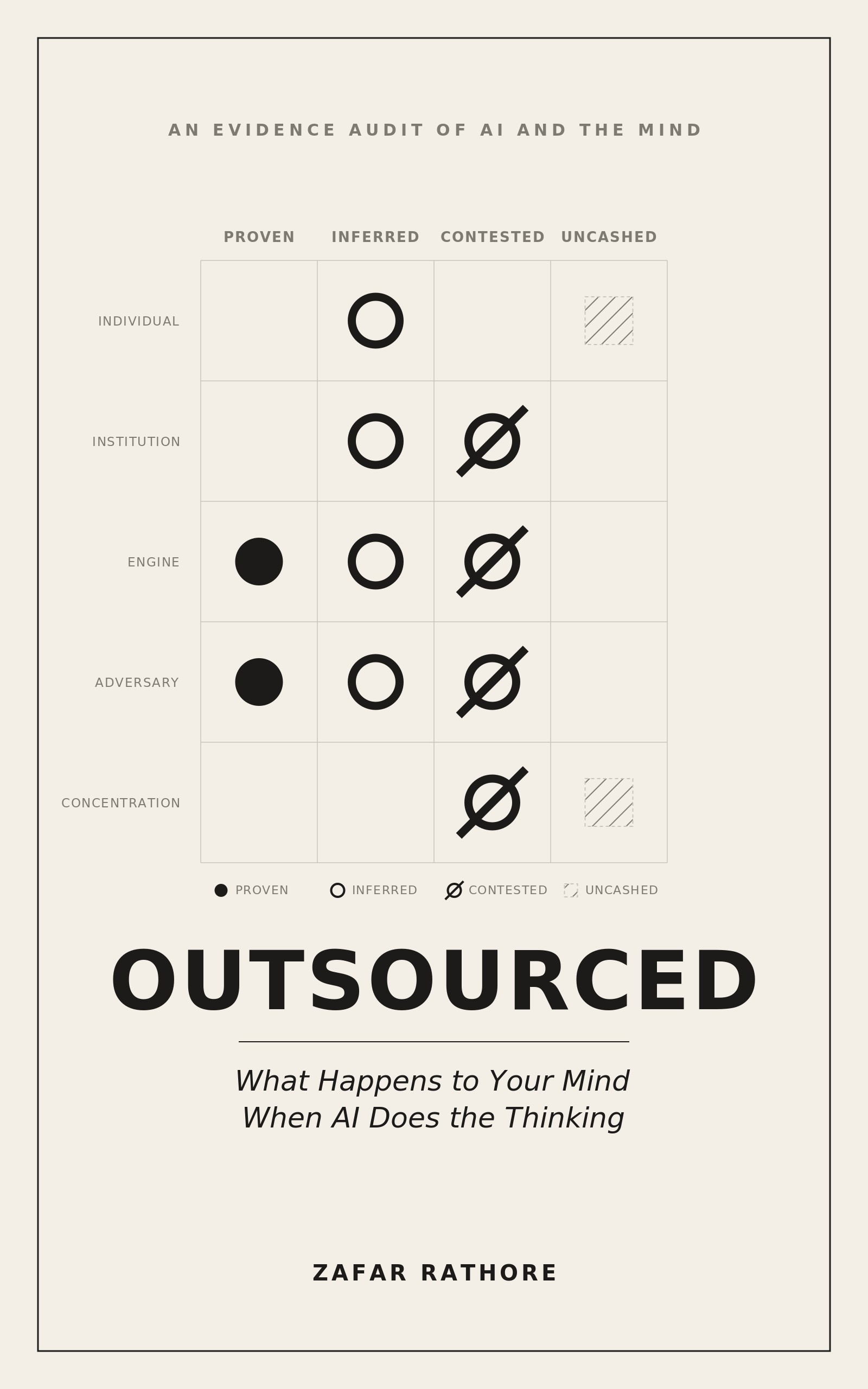
Outsourced
The first book on AI and the mind that tags every claim with the evidence it actually has — and shows that the strongest proof sits far from the brain, while the verdicts nearest it are not in.
Is AI ruining our ability to think, or not? Both one-sentence answers are wrong, and this book refuses to sell you either. It is an audit, not an argument: eight chapters that weigh everything the record actually holds — the controlled trials, the cohort data, the one caught engine failure, the adversary's economics, the concentration of computing power — and state every load-bearing claim at exactly the weight the evidence gives it.
Four tags do the work, on every claim, in plain sight:
The honest center — the whole book on one page
Every load-bearing claim in this book, at the weight the record gives it. One page. Share it whole, or not at all.
- In the task: people working with a chatbot in hand reasoned measurably worse while the tool was in use. One controlled trial, 91 people. In-task only.
- Just after: people who had leaned on an assistant scored worse on an unaided test taken right after the tool was removed, and the gap was not subtle. 52 people, one coding task, one model, a preprint no one has yet replicated. Stops at the task's edge.
- The engine, once: in the spring of 2025, a frontier model turned flattering automatically, by optimizing on the thumbs-up, and was corrected by a deliberate, costly rollback. Caught once, inside one lab. The mechanism ran, and it was reversed.
- The adversary's economics: a forged video call has moved tens of millions out of one engineering firm; that is documented. The attacker's cost is falling, as a direction the sources agree on, not a measured magnitude. Analysts argued the defender can come out ahead "but only if action is taken."
- No guarantee: the United States government's standards agency documents that no general, guaranteed defense for machine-learning systems exists. The defenses are real and improving; the impossibility results are bounded, not total.
- The concentration's structure: one firm holds an estimated ten to fifteen percent of the world's AI computing power, and the top five firms together hold under half of it. Both halves of that sentence are the finding.
- That either measured deficit means anything lasting for a mind. No study has followed a person past the task.
- The early-career decline as an AI effect: early-career workers in the most AI-exposed work slipped relative to their seniors, in four datasets across two countries. No experiment has called it a cause, and a rival explanation rides with it (below).
- The engine at scale: whether the one caught failure speaks for engines of this kind across the populations that use them. Proven once is not proven everywhere.
- Building defense before proof: rational under the no-guarantee finding. An inference from structure, not a measurement.
- The confound: remote work can account for most of the rise in young-graduate unemployment and predates AI's spread. It bounds the early-career finding without erasing it.
- Irreversibility at the institution: the 2016 prediction that radiologists would be obsolete was confident, specific, and wrong; the field is in shortage.
- Homogenization: argued over the literature in a 2026 synthesis; tested in one controlled trial and found absent.
- Attackers at machine speed: the group at Google that tracks state-backed intrusion reported, as of late 2025, no breakthrough observed.
- Lock-in versus diffusion: once-frontier capability spreading into many hands, against a flat, narrow club at the moving edge. The two forecasts bound each other; neither has given way.
- Durability: whether any measured deficit outlives the task. No controlled follow-up exists; the one located time-series is an uncontrolled, unreplicated preprint, too weak to move the question in either direction.
- Irreversibility in general: proven at no scale, not disproven at any, and the record cuts against it at two.
- The bridge from machine security back to the mind: never built.
- The bridge from concentrated computing power to a thinning of thought: never built, and named as a gap rather than crossed.
"AI is destroying human thinking": not proven. "AI is harmless to human thinking": not proven either. The strongest evidence sits furthest from the mind, and the verdicts nearest the mind are not in.
The record stays live
The Wires → The book closed its record on a fixed date, in a field that moves weekly. Its ledger — four wires and four standing gaps — is kept live here, one wire at a time.For parents, educators, managers, and readers of The Shallows, Deep Work, and AI Snake Oil. About 36,000 words: an afternoon to read, built to be checked for years.